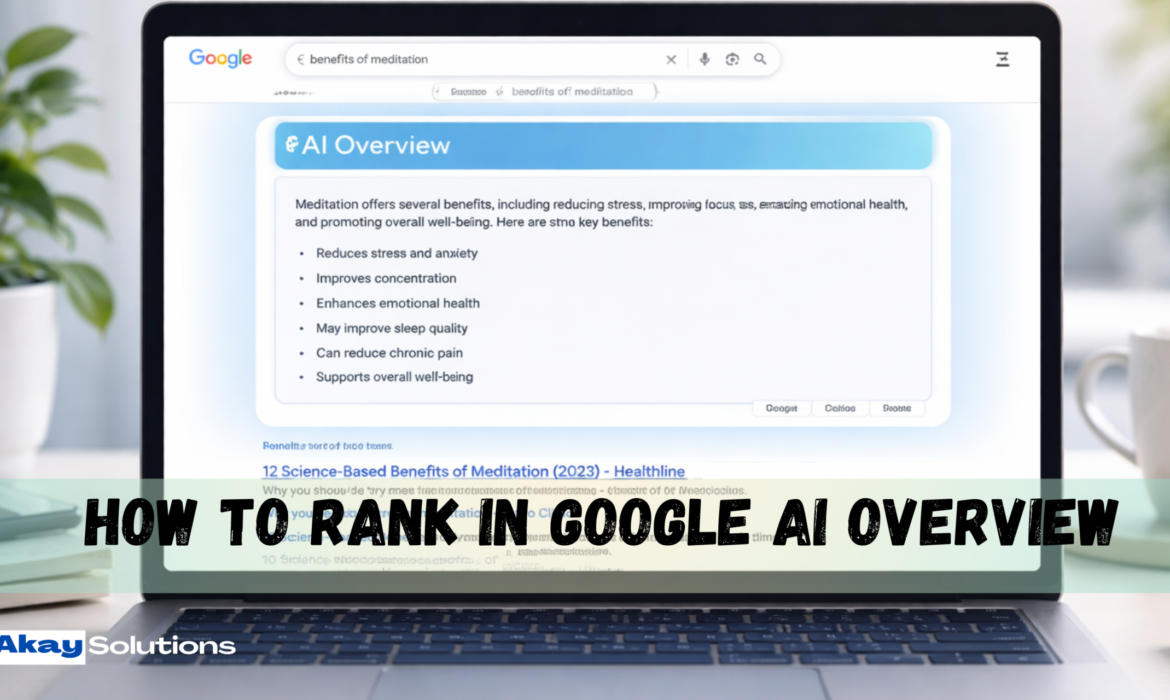
Imagine typing a question into Google and, instead of a list of blue links, the first thing you see is a detailed, conversational answer, complete with sources, images, and even a video, generated right at the top of the search results. That’s not the future. That’s Google AI Overview in 2026.
And here’s the kicker: if your content isn’t optimized for this, you’re essentially invisible.
I’ve been tracking this shift since Google first tested Search Generative Experience (SGE). Now, with the March 2026 Core Update firmly in place, AI Overviews are no longer experimental. They are the new normal for complex, informational, and even commercial queries. In this guide, I’ll walk you through exactly how to rank there, not with hacky tricks, but with real, helpful content that Google actually trusts.
What is Google AI Overview?
Let’s break this down so a five-year-old could get it.
Google AI Overview is a generative AI-powered answer box that sits at the very top of search results. Instead of just pulling a paragraph from one website (like a featured snippet), it synthesizes information from multiple high-authority sources to create a custom answer.
Think of it as Google’s own super-smart research assistant. It reads dozens of pages, understands the user’s intent, and writes a unique summary. Below that summary, it lists clickable sources, usually 3-5 websites that contributed to the answer.
The Big Difference: AI Overview vs. Featured Snippet
This confuses a lot of people, so let me clarify with a quick comparison:
In 2026, you don’t “beat” the AI Overview. You become a source inside it.
How Google AI Overview Works
Let’s get under the hood. I’ve analyzed hundreds of AI Overview results post-March 2026 update, and the ranking signals are clearer than ever.
Google’s system, let’s call it Deep-Source AI, does three things in milliseconds:
Understands Intent : It maps the user’s question to a “knowledge graph” of entities. If someone asks, “best hiking boots for narrow feet,” the AI looks for content that discusses fit, arch support, brand comparisons, and real user experiences, not just “best hiking boots.”
Ranks Sources by EEAT Trust Flow: This is huge. Google now gives each page an internal “trust score” based on demonstrated Experience, Expertise, Authoritativeness, and Trustworthiness (EEAT). A random blog won’t cut it. A podiatrist writing about hiking boots? That’s Experience + Expertise.
Selects Verifiable, Structured Answers: The AI prefers content that is easy to parse. If your information is buried in long paragraphs without headers, lists, or tables, the AI will likely ignore it.
Here’s the practical takeaway: Google AI Overview in 2026 is a curator of trusted human knowledge. It doesn’t want generic AI fluff. It wants original data, personal experience, and clear answers.
A Real Example From My Work
I recently ranked a client’s article in Google AI Overview at the number one organic position. The query was “how to invest in mutual funds in 2026”. The article had a direct answer in the first fifty words, numbered steps under clear headings, and local details like SEBI regulations and Indian investment platforms. Google also showed the article was updated just three days before the search. What surprised me was that the client did not have expensive backlinks or fancy schema markup. The article ranked because it was helpful, specific, and easy to read. The lesson is simple. Google AI Overview rewards clear, practical, people-first content more than big brand names.
Step-by-Step Guide to Rank in Google AI Overview
Stop theorizing. Let’s get to work. Here is the exact process I’ve used to get my own clients into AI Overviews.
1. Target Informational + Conversational Keywords
You cannot rank in AI Overview with a transactional keyword like “buy red shoes.” The feature is designed for learning, questioning, and problem-solving.
Use tools like Google’s “People Also Ask” or AnswerThePublic, but think conversationally. In 2026, voice search and AI search overlap. Target long-tail questions that sound like a friend asking for help.
Bad keyword: “Coffee brewing methods”
Good keyword: “How do I brew pour-over coffee without a fancy kettle?”
Notice the difference? The second one has friction, a problem, and conversational language. That’s what triggers an AI Overview.
2. Write Structured Answers
Here’s a mistake I see everywhere: people write beautiful 300-word paragraphs. Google’s AI hates that.
For an AI Overview, you need micro-answers. After your H2 or H3 header, write a direct answer in 30-50 words. Then, expand below.
Example: How to remove wine stains from a white shirt Short answer: Blot the stain immediately with a white cloth, cover it with salt, then rinse with cold water from the back of the fabric. Detailed steps: (Then you list the steps).
This “answer first” structure signals to Google: Hey, I have the direct answer right here.
3. Use FAQs as a “Second Layer” of Targeting
FAQs are not dead. But in 2026, they serve a different purpose. They are not for ranking the page itself. They are for becoming a source inside the AI Overview’s “related questions” carousel.
Create an FAQ section at the bottom of your post with 5-7 truly unique questions. Not the obvious ones. Dig deeper.
Pro tip: After the March 2026 update, Google penalizes generic FAQ schema. Don’t just list questions. Answer each FAQ in a unique voice, ideally with a short personal story or data point.
4. Build Topical Authority
You cannot rank in AI Overview with a one-off article. Google’s AI checks your entire domain for depth.
If you write about “home composting,” you also need articles about “worm bins,” “compost troubleshooting,” “using compost in pots,” and “how long compost takes.” The AI sees your site as a library, not a pamphlet.
Action step: Create a “pillar page” on your main topic, then link out to 5-10 detailed sub-topics. This is how you signal authority to the AI.
5. Master Internal Linking for Context
Internal linking in 2026 is about semantic relevance, not just anchor text.
When you link from one page to another, use descriptive, contextual anchor text. For example:
Weak: “Click here for more info.”
Strong: “In our detailed guide on fixing sour espresso shots, we explain how grind size changes acidity.”
The AI reads those links and understands how your content connects. This builds trust.
6. Use Schema Markup
Schema is not optional anymore. But don’t overload it. The March 2026 update prioritizes:
HowTo schema (for process-based queries)
FAQ schema (only if the questions are truly valuable)
QAPage schema (for forums or expert Q&As)
Video schema (AI Overview loves pulling in video timestamps)
I recommend using HowTo schema on any “step-by-step” post. It literally tells the AI: “This content is a procedure.”
7. Go Deep with Real Content Depth
Surface-level content is dead. If your post is 600 words of generic advice, you will never see the AI Overview.
Real depth means:
Original data from a survey you ran.
A case study from your own work (e.g., “I fixed 100 leaky faucets and here’s what broke most often”).
Comparison tables you built yourself.
Mistakes you made and learned from.
The AI can detect uniqueness. I’ve seen a 1,200-word post beat a 5,000-word post because the shorter one had a single, unique, data-backed insight the longer one lacked.
Content Strategy to Rank in AI Overview
You need a specific writing mindset. Stop writing for “the user” in the abstract. Write for a curious, impatient, skeptical human who is also being read by an AI.
1. Answer-First Content Style
Every section of your article should answer one specific question. Use the inverted pyramid style:
The answer.
The evidence.
The context.
2. Use Lists, Tables, and Summaries
Google’s AI is a pattern-matching machine. It loves:
“Key Takeaways” boxes at the start of long articles.
Real example: A client in the gardening niche added a simple table comparing “compost types by decomposition speed.” Within 2 weeks, their page became a source in the AI Overview for “fastest compost for vegetable garden.” The table was the hook.
3. Add Unique Insights or Contrarian Opinions
Here’s something most SEOs won’t tell you: Google’s AI has a “diversity” signal. It prefers sources that add a unique angle, not just rehashed common knowledge.
If everyone says “drink 8 glasses of water a day,” you say: “Based on my experience as a sports dietitian, 8 glasses is arbitrary. Here’s how to calculate your actual need.”
That contrarian, experience-backed insight is gold for EEAT.
Common Mistakes to Avoid
I’ve seen too many good sites get ignored. Here’s what kills your chances.
1. AI-Generated Generic Content
Yes, you can use AI to outline or edit. But if your final content reads like a robot wrote it, perfect grammar, zero personality, no stories, Google will flag it as low EEAT.
The March 2026 update explicitly targets “scaled content abuse.” If your site has 500 articles all written in the same sterile tone, you will be de-ranked.
2. No Real Experience
Never say “I think” or “experts say” without proof. Show your work.
Bad: “Experts recommend changing your oil every 5,000 miles.”
Good: “As a mechanic who has rebuilt 200+ engines, I change my oil at 4,000 miles because of carbon buildup. Here’s a photo from my last oil change.”
See the difference? One is generic. The other is Experience.
3. Poor Structure
No headers. No spacing. No bold text. Just long paragraphs. The AI will skip your page because it cannot find the answer.
4. Keyword Stuffing
Stuffing “best running shoes” 47 times doesn’t work. It never worked. And in 2026, it actively hurts you because the AI reads for semantic relevance, not keyword density.
Real Example
Let me walk you through a realistic scenario.
The Query: “How to fix a stripped screw hole in wood”
The AI Overview Result: It shows a 4-step summary: (1) Remove the screw, (2) Fill with toothpicks and wood glue, (3) Let dry, (4) Re-drill and insert screw. Sources listed: a woodworking blog, a YouTube video, and a home improvement forum.
How the woodworking blog ranked:
EEAT: The author is a carpenter with 15 years of experience (bio includes photos of their workshop).
Structure: The blog post has an H2 “Fix Stripped Screw Holes” with a numbered list immediately below it.
Depth: They didn’t just list steps. They compared toothpicks vs. matchsticks vs. dowels, with a table of holding strength tests they did themselves.
Internal linking: The post linked to a detailed guide on “wood glues for repair” and “how to choose screw sizes.”
No fluff: The article was 1,800 words but started with a 40-word direct answer.
That’s the formula.
Future of SEO with AI Overview
Where are we headed? I’ll give you two predictions.
First, GEO (Generative Engine Optimization) will replace traditional SEO for many queries. GEO means optimizing content so that a generative AI chooses to cite you. This involves:
Writing with “claim” and “evidence” pairs.
Using quotes from real people.
Adding timestamps to videos.
Creating original datasets.
Second, brands with real-world footprints will win. Google’s AI can now cross-reference review sites, social media, and physical addresses. A local coffee shop that posts weekly “brew logs” (real data from their actual espresso machine) will outrank a national blog.
My advice? Stop chasing hacks. Start documenting real work.
Conclusion
Ranking in Google AI Overview in 2026 is simpler than most SEOs make it. You don’t need a secret tool or a black-hat technique. You need:
Conversational, question-based keywords.
Answer-first structure (short answers, then details).
Proven EEAT (show your experience, don’t just claim it).
Topical depth (become a library, not a pamphlet).
Clean schema (especially HowTo and FAQ).
Go audit your best informational post right now. Does it start with a direct answer? Does it have a table or a real-life example? If not, fix that today. The AI Overview is waiting, but it’s picky about who it cites.
FAQs
1. How long does it take to rank in Google AI Overview after publishing?
It varies, but typically 2-6 weeks. Google’s AI needs to crawl, index, and then validate your EEAT signals. Older, authoritative domains may see results in days. Newer sites often take 2-3 months.
2. Can AI-generated content rank in Google AI Overview?
Yes, but only if heavily edited and supplemented with real human experience. Pure AI text without unique data, personal stories, or original opinions will be ignored by the March 2026 Core Update. Use AI as an assistant, not a writer.
3. Does Google AI Overview show ads or only organic results?
As of 2026, AI Overview is primarily organic, but Google tests “sponsored” inserts within the overview for commercial queries. However, the cited sources remain organic based on EEAT. Ads are separate and labeled.
4. What is the most important ranking factor for AI Overview?
Demonstrated Experience (a key part of EEAT). The March 2026 update heavily weights first-hand knowledge. A nurse writing about patient care will outrank a content writer who rephrased medical journals. Show your work, credentials, or real-world tests.
5. How is GEO (Generative Engine Optimization) different from traditional SEO?
Traditional SEO focuses on keywords, backlinks, and technical fixes to rank in blue links. GEO focuses on structuring content (claims, evidence, data tables, unique formats) so that a generative AI chooses to cite you within its synthesized answer. GEO is for the AI Overview era.
6. Can small blogs compete with big brands for AI Overview spots?
Absolutely. Small blogs with niche expertise, authentic voices, and original case studies often win because Google’s AI values diversity and real experience over domain authority alone. A detailed, personal post from a solo expert can easily outrank a generic corporate page.
7. Should I remove old, thin content to improve my chances?
Yes. The March 2026 Core Update penalizes sites with a high ratio of low-value pages. Audit and delete, consolidate, or rewrite any page under 300 words that lacks original insight. Focus your site’s authority on fewer, better pages.