Learn how digital marketing helps small businesses grow. Step-by-step guide with real examples, SEO tips, and cost-effective strategies.
Introduction
Let me ask you something. When was the last time you searched for a product or service without picking up your phone? Probably never. That is the reality of doing business in 2026.
I remember talking to a furniture store owner last year. He told me, “My shop is on a busy road. Everyone drives past. That should be enough.” But when I asked him how many new customers found him through Google, he went silent. He had no idea.
That is the problem. Being on a busy street is not enough anymore because your customers are not just walking by. They are scrolling, searching, and comparing options online before they ever step outside.
Running a business today without digital marketing for business is like opening a restaurant but hiding the menu inside a locked drawer. People want to find you. They want to know about you. You just need to make it easy for them.
In this article, I will show you exactly how to use online marketing strategies to run your business better, reach more customers, and grow without breaking the bank.
What is Digital Marketing for Business?
Simple Explanation
Let me break this down in plain English. Digital marketing for business means using the internet to tell people who you are, what you sell, and why they should care.
Think of it as your digital storefront. But unlike a physical store that closes at 8 PM, this one stays open 24 hours a day, 7 days a week. It works while you sleep, while you eat dinner, and while you take a vacation.
The channels include search engines like Google, social media platforms like Instagram and LinkedIn, email, and your own website. Each channel serves a different purpose, but together they create a complete system for attracting and keeping customers.
Why Every Business Needs It
Here is a truth that many business owners learn the hard way. Relying only on word of mouth or foot traffic is risky. What if a new highway diverts traffic away from your street? What if a bigger competitor opens next door?
Digital marketing gives you control. You are no longer waiting for customers to stumble upon you. You are actively going to where they already are.
I have seen a home cleaning service double its customers in three months simply by showing up on Google Maps. I have watched a freelance graphic designer fill her calendar using only LinkedIn posts. These are not lucky accidents. They are the results of understanding how digital marketing can help to grow your business.
Benefits of Running a Business with Digital Marketing
Cost-effective marketing
Let us talk about money because that is what matters to most business owners.
A single 30-second TV commercial during local news can cost you $5,000 or more. And here is the kicker, you have no idea who actually watched it. A billboard on a busy highway might cost $2,000 per month, but how many of those drivers are even interested in your product?
Now compare that to a Facebook ad campaign. For $100, you can show your ad to 5,000 people who have already shown interest in businesses like yours. You only pay when someone clicks or engages. That is small business marketing done right.
I am not saying traditional advertising has no value. I am saying that for most small businesses, digital gives you ten times the return for one-tenth the cost.
Targeted audience reach
Precision is everything. When you run a digital ad, you are not shouting into a crowd. You are whispering into the ear of the right person at the right time.
Want to sell baby clothes? Show your ads to new parents within ten miles of your store. Selling accounting software for restaurants? Target restaurant owners who have recently searched for “better bookkeeping.”
You can filter by age, gender, income level, interests, online behavior, and even recent life events like moving to a new city or getting engaged. Traditional advertising cannot do this. Only digital advertising gives you this level of control.
Measurable results
I used to work with a restaurant owner who spent $1,000 per month on newspaper ads. When I asked him how many customers came from those ads, he shrugged. “Hard to say,” he told me. “People just show up.”
That uncertainty disappears with digital marketing. Every click, every view, every purchase can be tracked.
You will know exactly how many people saw your post, how many clicked through to your website, and how many actually bought something. If a campaign is losing money, you turn it off immediately. If it is working, you increase the budget. No guessing. No hoping. Just data.
Brand building
Trust is the currency of business. And trust is built through repeated, positive interactions.
Every time someone sees your helpful blog post, watches your explainer video, or reads a positive review you shared, a small deposit goes into their trust bank account. Eventually, when they need what you sell, your name is the first one that comes to mind.
That is online branding in action. It is not about being famous. It is about being familiar to the right people.
Step-by-Step Guide to Running a Business Using Digital Marketing
Step 1 – Build Your Online Presence (Website + Branding)
Before you do anything else, you need a home base. That is your website.
A Facebook page is not enough because you do not own Facebook. They can change their rules, limit your reach, or even shut down your account. Your website is the only piece of online real estate that you fully control.
Start simple. You do not need a $10,000 custom design. Use a platform like Squarespace, Wix, or WordPress. Include these essential pages:
Home page (what you do and who it is for)
About page (your story and why you care)
Services or Products page (what you sell and pricing)
Contact page (phone, email, address, and a simple form)
Actionable tip: Add a clear phone number to the top corner of every page. You would be shocked how many businesses hide their contact information.
Step 2 – Use SEO to Get Free Traffic
SEO for business is simply the practice of making your website easy for Google to understand and recommend.
When someone types “best coffee shop near me” into Google, the search engine has to decide which businesses to show. It looks for signals like location, customer reviews, website content, and how fast your site loads.
You do not need to be an expert. Just follow these basics:
Put your city and service in your page titles. “Plumber in Austin | 24/7 Emergency Repairs” is better than just “Home.”
Claim and fill out your Google Business Profile completely. Add photos, hours, and services.
Ask happy customers to leave Google reviews. This is one of the most powerful ranking factors.
Write blog posts answering common customer questions. “How to unclog a drain without chemicals” is a perfect example.
SEO takes time… usually three to six months, but it is free traffic that keeps coming long after you publish.
Step 3 – Social Media Marketing Strategy
Here is where most business owners go wrong. They join every platform, post randomly for two weeks, get discouraged, and quit.
Stop that. Pick one platform. Just one.
If you sell to other businesses, choose LinkedIn. If you sell products that look good in photos, choose Instagram. If you make helpful videos, choose YouTube or TikTok. If you are a local service business, choose Facebook.
Post three to five times per week. Share behind-the-scenes content. Show your face. Answer questions. Reply to every comment.
Social media marketing is not about going viral. It is about showing up consistently and building relationships over time.
Actionable tip: Spend ten minutes every morning engaging with other accounts in your area or industry. Comment genuinely. Do not just say “Great post.” Say something specific.
Step 4 – Content Marketing for Trust
I want to share a mindset shift that changed everything for me. Stop thinking like a salesperson and start thinking like a teacher.
Content marketing means giving away your best advice for free. Yes, for free. And that feels scary.
“What if they take my advice and do it themselves?” Good. Then they were never going to pay you anyway. But the people who realize how complicated your work really is? They will call you because they trust you.
Create a simple content plan:
Write one blog post per week answering a common question.
Record a two-minute video showing how you solve a problem.
Create a downloadable checklist or guide.
Share customer success stories (with permission).
Every piece of content is a small advertisement for your expertise. And unlike a paid ad, it keeps working for months or years.
Step 5 – Paid Ads for Fast Growth
Organic marketing (free methods) is like planting a tree. It takes time to grow, but the results are lasting. Paid advertising is like buying a fully grown tree. It costs money, but you get results immediately.
If you need customers next week, run ads.
Start small. I mean really small. Put $100 into Google Ads for a specific keyword like “emergency dentist near me.” Or run a $50 Facebook ad offering a free consultation.
The secret to profitable digital advertising is testing. Run two different ad versions for five days. See which one gets more clicks or calls. Then turn off the loser and put all your money into the winner.
Actionable tip: Use video in your ads whenever possible. Video ads get significantly higher engagement than image ads on most platforms.
Step 6 – Email Marketing & Retargeting
Here is a heartbreaking stat. About 98% of people who visit your website leave without buying or contacting you. They get distracted. They close the tab. They forget.
Collect email addresses using a simple popup on your website. Offer something valuable in exchange, a discount code, a free guide, or a checklist. Then send a welcome email immediately.
After that, send one helpful email per week. Not a sales pitch. Helpful content. A tip. A story. A customer win.
Lead generation is not about tricking people into buying. It is about staying top of mind so that when they are ready, they think of you.
Actionable tip: Set up an automated three-email welcome sequence. Email one: welcome and free gift. Email two: helpful tip or case study. Email three: special offer. This alone can increase sales by 50% or more.
Real-Life Example (Case Study Style)
Let me tell you about a real business I helped. It is a small landscaping company called GreenCare. The owner, Mike, had been in business for eight years. He relied on yard signs and referrals. But growth had stalled.
We started with SEO for business. We optimized his Google Business Profile with 20 photos, a complete service list, and a link to his website. We also asked his five best customers to leave detailed reviews.
Then we added content marketing. Mike started posting a two-minute video every Wednesday showing his team transforming an overgrown yard into a beautiful landscape. Nothing fancy. Just a phone camera and some quick editing.
Finally, we ran a tiny Google Ads campaign targeting homeowners within a five-mile radius. The ad said, “First mow free for new customers.”
The results after four months:
Website visits increased by 280%
Phone calls went from 8 per week to 28 per week
New customer signups doubled from 6 to 12 per month
Monthly revenue grew from $12,000 to $19,000
Mike spent exactly $600 on ads and zero dollars on content creation. That is the power of understanding how digital marketing can help to grow your business without spending a fortune.
Common Mistakes to Avoid
Ignoring SEO
I see this constantly. A business spends thousands on a beautiful website but forgets to add basic SEO. Google has no idea what the site is about. So it never shows up in search results.
Fix it: Add your primary keyword to your homepage title, your first heading, and your first paragraph. Then add your city name. That alone will help.
Not understanding audience
You are not your customer. Just because you love TikTok does not mean your 60-year-old clients are there. I watched a divorce lawyer waste $3,000 on Instagram ads. His clients were searching Google. Not Instagram.
Fix it: Ask ten existing customers where they found you and what platforms they use. Let their answers guide you.
Inconsistent posting
Posting once a month is the same as not posting at all. Algorithms forget you. Audiences forget you. You become invisible.
Fix it: Use a simple calendar. Plan one week of posts every Sunday. Batch create your content in one hour. It is easier than you think.
Focusing only on sales
Nobody likes a friend who only asks for money. The same is true for brands. If every post says “Buy now,” people will ignore you or unfollow you.
Fix it: Follow the 80/20 rule. 80% of your posts should be helpful, entertaining, or interesting. 20% can be sales-focused. That balance builds real relationships.
Advanced Tips to Scale Your Business
Automation tools
You cannot manually reply to every message when you have thousands of followers. That is where automation helps.
Use free tools to schedule social media posts for the week. Set up automatic email replies for common questions. Use a chatbot to collect basic information from leads after hours.
Start with free versions. Upgrade only when you absolutely need to.
Data-driven marketing
Stop guessing. Start measuring.
Look at your numbers every week. Which blog post got the most views? Which ad got the cheapest click? Which email subject line got the most opens?
Double down on what is working. Kill what is not. That is how you grow faster without spending more money.
AI tools in digital marketing
Artificial intelligence is not here to replace you. It is here to help you work faster.
Use AI to brainstorm blog topics. Use it to rewrite your email subject lines ten different ways so you can pick the best one. Use it to summarize a long video into five social media posts.
But here is the rule: always edit. Always add your voice. Always check for accuracy. AI is an assistant, not the expert.
Conversion optimization
Getting traffic is useless if nobody buys. Conversion optimization is the art of turning visitors into customers.
Test one small change at a time. Change the color of your “Book Now” button from blue to green. Shorten your contact form from ten fields to three. Add customer photos next to your signup box. These tiny tweaks can double your sales.
Digital Marketing Tools You Can Use
You do not need a hundred tools. You need a handful of good ones.
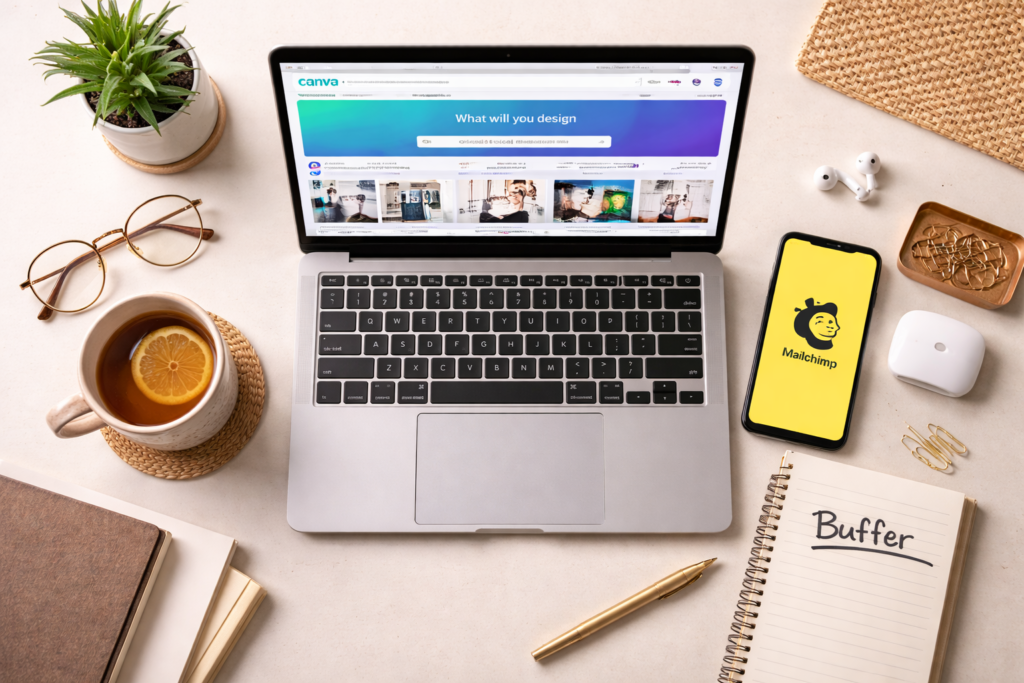
For scheduling social media: Buffer or Later. Free plans let you schedule weeks in advance.
For email marketing: Mailchimp or Brevo. Free for small lists under 500 subscribers.
For analytics: Google Analytics. Free and powerful. See exactly where your traffic comes from.
For keyword research: Google Keyword Planner or AnswerThePublic. Both have free versions.
For design: Canva. Free templates for social posts, flyers, and business cards.
For SEO checks: Ubersuggest or Moz Free Tools. Find broken links and missing keywords.
Pick two tools to start. Master them. Add more only when needed.
Conclusion
Digital marketing is not a magic trick. It is not a secret formula. It is simply a set of tools and strategies that help you connect with the customers who are already looking for you.
The beauty of digital marketing for business is that it works for everyone. A one-person freelance writer. A five-person plumbing company. A 50-person boutique hotel. The principles are the same. Only the execution changes.
You do not need a big budget. You do not need a marketing degree. You need consistency, curiosity, and the willingness to try things.
Start today. Claim your Google Business Profile. Post one photo of your work. Write one helpful blog post. Send one email to your customers.
Small actions, repeated daily, lead to massive results over time. That is how you run a business with digital marketing. Not by doing everything at once. But by starting somewhere and never stopping.
FAQs
What is digital marketing for business?
It is the practice of using online channels like search engines, social media, email, and websites to attract, engage, and convert customers. Unlike traditional advertising, digital marketing is measurable, targeted, and often more affordable for small businesses.
How can I start digital marketing for my business?
Start with these three steps: claim your Google Business Profile, create a simple website with your services and contact information, and pick one social media platform to post on consistently. Do not try everything at once. Master one channel before adding another.
Is digital marketing good for small businesses?
Yes, absolutely. In fact, digital marketing is better for small businesses than for large corporations. You can compete without a huge budget by being more personal, more responsive, and more authentic. Many small businesses have grown into large ones using only digital strategies.
How much does digital marketing cost?
You can start for free using organic methods like SEO, social media posting, and email marketing. For paid advertising, a budget of $100 to $500 per month is common for local businesses. As you grow, many experts recommend spending 5% to 10% of your revenue on marketing.
Which platform is best for business marketing?
There is no single best platform. The right choice depends on your industry and audience. B2B companies often succeed on LinkedIn. Local service businesses do well on Facebook and Google. Visual products like clothing or art perform best on Instagram or Pinterest. Ask your existing customers where they spend time online.
How long does it take to see results?
It depends on the strategy. Paid ads can show results within days. SEO and content marketing typically take three to six months to show significant results. Email marketing often shows results within weeks. The key is patience and consistency. Most businesses quit too early.
Can I do digital marketing myself without hiring an agency?
Yes, especially in the first year. The basics of SEO, social media, and email marketing are learnable through free resources like YouTube and blogs. Hire an agency only when you are too busy to do it yourself or when you want to scale faster. Doing it yourself first teaches you what actually works for your unique business.